
Single Shaft vs Two Shaft Shredder: Which One Fits Your Waste?
Compare single shaft and two shaft shredders by material, output size, capacity, process role, safety and total project requirements.

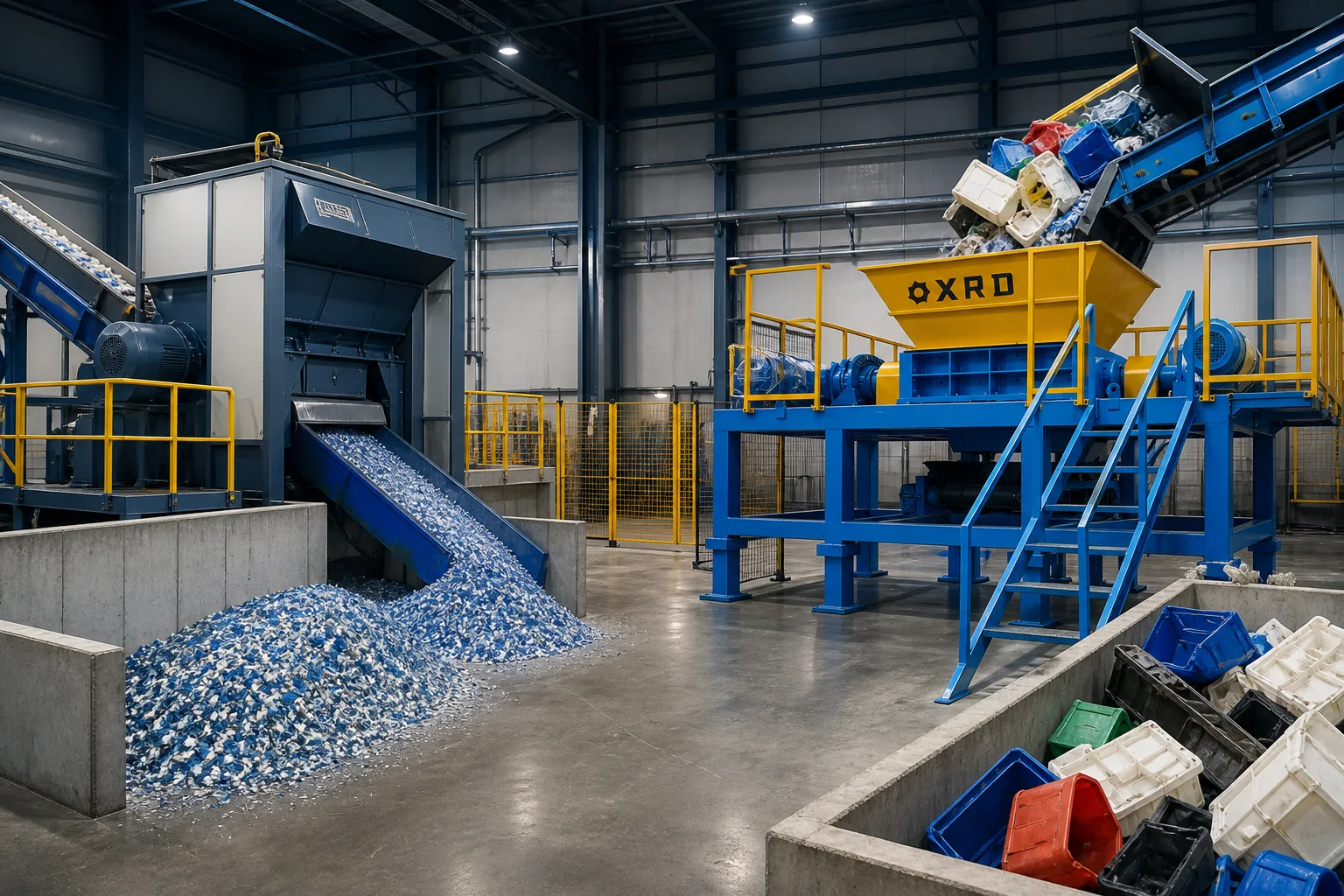
Choose a single shaft shredder when repeatable, screen-controlled output is the main requirement. Choose a two shaft shredder when the first job is to grip and reduce bulky, irregular or mixed waste with high torque. If both coarse opening and controlled final size are required, the correct answer may be a two-stage line rather than one machine.
The Short Decision Rule
The difference between a single shaft and a two shaft shredder is not simply one rotor versus two. Each design solves a different process problem. A single shaft machine normally combines a rotor, fixed counter knives, a hydraulic pusher and a screen. It repeatedly cuts material until the pieces can pass through the selected screen. A two shaft machine uses two counter-rotating shafts with intermeshing cutters to pull, tear and shear incoming material. It is commonly used where aggressive intake and primary size reduction matter more than a narrowly controlled final particle size.
For an overseas buyer, the fastest way to choose is to start at the next process. If a washing line, granulator, extrusion line, boiler or baler needs a reasonably consistent feed size, screen-controlled single shaft reduction may be valuable. If the immediate problem is opening bales, breaking large containers, reducing bulky furniture, tearing mixed industrial waste or preparing material for separation, a two shaft pre-shredder is often the more relevant starting point.
Neither design is universally better. The better machine is the one that produces the required material condition at the lowest acceptable project risk. That decision depends on feed geometry, composition, contaminants, output specification, operating hours, feeding method and downstream equipment—not on motor power or quotation price alone.
Buyer rule: controlled final sizing points toward single shaft; difficult primary reduction points toward two shaft; demanding projects may need both stages.
How the Two Shredder Designs Work
A single shaft shredder typically uses one horizontal rotor fitted with cutters. A hydraulic ram or pusher presents material to the rotor, where moving knives work against fixed counter knives. Material that is still too large remains in the cutting area. Once it becomes small enough, it passes through a screen below or around the rotor. Changing the screen opening can change the discharge target, although the real particle distribution still depends on material thickness, shape, flexibility and operating conditions.
A two shaft shredder works differently. Two slow-speed shafts rotate toward one another. Cutter hooks engage the feed, draw it downward and tear or shear it between the cutter stacks. Many primary two shaft shredders operate without a sizing screen. Their discharge therefore depends on cutter width, hook geometry, shaft speed, material behavior and the number of cutting passes. Output is normally less uniform than screen-controlled single shaft output, but the machine can be better at accepting large and awkward items.
The feeding behavior is just as important as the cutting action. A single shaft machine often needs the pusher to keep light or irregular material in contact with the rotor. A two shaft machine can self-feed when the cutter hooks obtain a reliable bite, but smooth, round, elastic or bridging items may still require hopper, cutter or feeding adjustments. A supplier should explain how the proposed machine will grip the buyer's actual waste, not only show an empty-machine drawing.
| Comparison point | Single shaft shredder | Two shaft shredder |
|---|---|---|
| Cutting principle | Rotor and counter knives with repeated cutting | Two intermeshing cutter shafts that grip, tear and shear |
| Typical feed control | Hydraulic pusher or ram | Self-feeding cutter hooks, sometimes assisted feeding |
| Output control | Usually controlled by a screen | Usually determined by cutters and material behavior |
| Common process role | Controlled or secondary size reduction | Primary reduction and material opening |
Start With Output Size and the Downstream Process
Output size is one of the strongest selection signals. Buyers often request a number such as 20 mm, 50 mm or 100 mm without explaining what happens next. That can produce a technically incomplete proposal. The supplier needs to know whether the material will be magnetically separated, manually sorted, air classified, washed, granulated, pelletized, baled, combusted as RDF or transported for another processor. Each downstream step has a different tolerance for oversize pieces, fines, long strips and inconsistent flow.
A screen can make a single shaft machine useful when the next process needs a repeatable maximum size. However, a smaller screen opening normally means more cutting passes, more residence time and potentially lower throughput. Flexible film, textiles and stringy materials may wrap or behave differently from rigid plastics, even with the same nominal screen. The screen number should therefore be treated as one configuration input, not a guaranteed one-to-one particle dimension.
A two shaft shredder is often selected when coarse output is acceptable or when another machine will perform final sizing. Cutter width and hook design influence the resulting strips and chunks, but mixed feed rarely produces identical pieces. If a buyer expects both aggressive intake of bulky waste and tight final sizing from one screenless primary shredder, the requirement should be challenged. A pre-shredder followed by a single shaft machine, granulator or screen-and-return loop may provide a more stable process.
- Define the downstream machine or destination before specifying output size.
- State the acceptable size range and oversize tolerance, not only one number.
- Explain whether fines, long strips or exposed metal create a problem.
- Ask how output control affects throughput, wear and power consumption.
- Confirm whether one machine can meet the requirement or a second stage is needed.
Match the Machine to Material Behavior
Material names alone are too broad for reliable selection. 'Plastic waste' may mean clean injection-molding runners, thick purgings, hollow drums, flexible film, woven bags, pipes, reinforced components or a contaminated mixture. 'Industrial waste' may contain wood, textiles, packaging, light metal, rubber and unexpected hard objects. These feeds have different bulk density, strength, elasticity, abrasiveness and gripping behavior.
Single shaft shredders are commonly evaluated for relatively consistent plastic production scrap, wood, paper, cardboard, textile and similar streams where the pusher can present material to the rotor and the screen adds value. They can also serve as a secondary stage after a pre-shredder. The exact cutter, rotor and screen configuration must still be selected around the material; a generic single shaft label does not guarantee suitability for every plastic or wood application.
Two shaft shredders are commonly evaluated for bulky, irregular or mixed items such as large containers, pallets, furniture, appliances, tires, mixed commercial waste and industrial rejects. Their high-torque, low-speed tearing action is useful when the process goal is volume reduction, product destruction, opening material for separation or protecting a downstream machine from oversized feed. Abrasive metal, stones, thick shafts and other hard contaminants require explicit review because they can change cutter life, protection logic and the entire system design.
The most useful evidence is representative material. Send clear photos with a scale reference, the largest item dimensions, approximate composition and typical contamination. For variable waste, show both normal and worst-case feed. When commercial risk is high, material testing or a documented engineering review is more trustworthy than a supplier promising capacity from a short material name.
Compare Capacity, Torque and Energy Without Being Misled
A shredder capacity figure is conditional. It changes with bulk density, piece size, material strength, moisture, contamination, cutter condition, feeding continuity and required output. A machine processing dense rigid scrap can show a very different tonnes-per-hour result from the same machine processing light, hollow products. Buyers should ask for the assumptions behind a capacity claim and determine whether the value is an average, a peak or a tested result.
Motor power is also an incomplete comparison. A two shaft primary shredder is designed around available shaft torque, cutter geometry, gearbox ratio and protection control. A single shaft machine must balance rotor speed, cutting action, pusher cycle and screen resistance. Two proposals with the same installed kilowatts can behave very differently. More power does not correct a poor feed opening, unsuitable cutters, unstable feeding or an unrealistic output target.
For the XRD60 two shaft shredder, currently verified reference specifications include 74 kW installed power, a 620 × 1080 mm cutting chamber, a 42CrMo main shaft and PLC control. These facts describe the reference machine; they do not create a universal capacity promise. XRD confirms application-dependent values only after reviewing the material, required throughput, discharge target, feeding method and project conditions.
Energy should be assessed at line level. A primary shredder that prepares stable feed for separation or secondary reduction may reduce downstream jams even if it adds another drive. Conversely, over-shredding material to a smaller size than the next process requires consumes time, cutter life and electricity without creating buyer value. The correct comparison is useful output per operating hour across the complete line, not the nameplate power of one machine.
Ask every supplier to state the material and operating assumptions behind throughput. A capacity number without feed conditions is not a reliable purchasing basis.
When a Single Shaft Shredder Is Usually the Better Fit
A single shaft shredder deserves priority when discharge consistency directly affects product quality or downstream stability. Examples include preparing clean plastic scrap for a granulator or washing line, producing controlled wood chips for a specified next process, reducing production waste before recycling, or processing a relatively stable material stream where a screen can prevent unacceptable oversize pieces.
The design can also be attractive where the plant wants one controlled sizing stage and the largest feed pieces already fit the hopper and rotor. The hydraulic pusher helps maintain contact with the cutting rotor, especially for light or loose material. Screen changes may give the plant useful flexibility, although each screen option should be evaluated for realistic throughput and wear.
Do not choose single shaft only because the final pieces look more uniform in a video. Confirm that the largest feed can enter safely, that long or flexible material will not create wrapping problems, that contaminants are within the machine's tolerance and that the pusher cycle suits the feed. The buyer should also ask how quickly the screen, cutters and counter knives can be inspected or serviced.
- Relatively consistent feed material
- A genuine need for screen-controlled discharge
- Secondary reduction after bulky items have been opened
- Downstream equipment with a defined maximum feed size
- Plants prepared to manage screen and cutting-clearance maintenance
When a Two Shaft Shredder Is Usually the Better Fit
A two shaft shredder deserves priority when the feed is too bulky, irregular or difficult for a controlled-sizing machine to accept efficiently. The counter-rotating cutters can pull large items into the chamber and reduce their volume without requiring a small screen. This makes the design relevant for primary shredding, material opening, product destruction and protection of downstream sorting or size-reduction equipment.
Common project discussions include bulky waste, mixed industrial or commercial waste, large plastic containers, pallets, household items, tires, appliances and packaged rejects. Suitability is still conditional. Thin film can wrap, smooth drums can bridge, reinforced items can accelerate wear and unexpected metal can overload the cutting system. Cutter thickness, hook count, chamber opening, hopper geometry and automatic reversal logic should be connected to those risks.
A buyer should accept that screenless two shaft output is a distribution rather than one exact dimension. If the proposal promises a precise final size, ask what mechanism controls it. Some projects add a screen, recirculation or secondary shredder, but that changes the system scope. A clear supplier will distinguish primary reduction from final sizing and will not hide a second-stage requirement to make the first quotation appear simpler.
- Bulky or awkward feed that must be grabbed and opened
- Mixed waste where primary reduction comes before sorting
- Volume reduction or product destruction
- Pre-shredding before a granulator, separator or single shaft stage
- Projects that value high-torque tearing over narrow particle-size control
When the Correct Answer Is a Two-Stage System
The single-versus-two-shaft question sometimes creates a false choice. A recycling line may need the strengths of both. A two shaft machine can first open bulky items, reduce peak feed size and create a steadier flow. A second single shaft shredder or granulator can then produce the controlled size required for washing, separation, RDF preparation, extrusion or another final process.
A two-stage line increases capital cost, controls and floor-space requirements, but it may reduce the load shocks and bridging problems experienced by a single machine asked to perform incompatible tasks. It can also allow maintenance or configuration decisions to be separated: the primary stage is optimized for intake and protection, while the secondary stage is optimized for sizing and product quality.
The decision should be based on a process flow, not a product catalogue. Map the material from unloading to final collection. Identify every transfer point, magnet, separator, screen, conveyor, dust-control requirement and access zone. Then check whether the selected machines can exchange material at compatible rates. A high-capacity primary shredder does not improve the line if the downstream conveyor or separator becomes the bottleneck.
| Project objective | Likely process direction | Key verification |
|---|---|---|
| Open bulky mixed waste for sorting | Two shaft primary shredder | Grip, contamination tolerance and separator feed |
| Produce controlled plastic regrind feed | Single shaft and/or granulator | Screen, temperature, fines and downstream limit |
| Handle bulky feed and control final size | Two shaft plus secondary sizing | Inter-stage balance and oversize strategy |
| Reduce transport volume only | Often primary two shaft | Required compaction, loading and discharge method |
Include Safety, Maintenance and Site Conditions
Shredder selection is incomplete without guarding and energy-isolation planning. OSHA's general machine-guarding guidance identifies hazards from points of operation, ingoing nip points, rotating parts and flying material. Local regulations differ, so the buyer's responsible engineer must review guarding, interlocks, emergency stops, access platforms, lockout procedures and operator training for the installation country and site.
Maintenance access affects both safety and uptime. Ask how cutters are inspected, how the chamber is cleared, which guards or covers must be removed, how heavy components are lifted and how unexpected stored energy is controlled. Confirm access around gearboxes, bearings, screens, pusher systems, conveyors and electrical cabinets before approving the layout. A machine that fits the floor plan but cannot be serviced safely is not a complete solution.
Export projects also require voltage, frequency, ambient temperature, elevation, dust, moisture, local electrical practice and documentation to be confirmed. These inputs can change motors, cooling, enclosures, controls and spare-parts planning. The supplier should separate verified standard specifications from items that remain subject to project review.
Safety requirements must be confirmed by the buyer's qualified local team. A blog comparison cannot replace a site-specific risk assessment or applicable regulations.
What to Send Before Requesting a Quotation
A useful quotation begins with a useful project brief. Sending only 'plastic shredder price' forces the supplier to guess the feed, process and scope. The resulting prices will not be directly comparable. A professional inquiry should describe the material and the business outcome, then give suppliers the same technical basis.
Start with photos and videos of normal feed and difficult feed. Add the largest dimensions, approximate piece weight, bulk density if known, hourly or shift throughput, operating hours, target output range and downstream destination. State known contaminants, prohibited items and whether feeding will be manual, by loader, by grab or by conveyor. Include the destination country, site voltage, available floor space and desired delivery scope.
Ask each supplier to return a process explanation, included-equipment list, confirmed specifications, project-dependent assumptions, utility requirements and exclusions. Compare the complete scope: hopper, shredder, base, conveyors, separators, controls, platforms, spare parts, documentation, installation support and shipping preparation. A lower machine price may simply move essential costs outside the quotation.
For XRD project review, the first decision is not whether the buyer wants one shaft or two. It is whether the waste must be opened, reduced to a controlled size, prepared for sorting or delivered into another process. Send those requirements and XRD can identify the next technical questions before recommending a machine direction.
- Material composition, photos, videos and difficult contaminants
- Normal and maximum feed dimensions
- Required average capacity and operating schedule
- Target output range and downstream equipment
- Feeding, discharge and separation method
- Country, voltage, layout limits and project timeline
Frequently Asked Questions
Is a two shaft shredder better than a single shaft shredder?+
Not universally. A two shaft shredder is usually better for high-torque primary reduction of bulky, irregular or mixed feed. A single shaft shredder is usually better when a screen-controlled output size is important. The correct choice depends on the material and downstream process.
Which shredder produces a more uniform output size?+
A single shaft shredder normally produces a more controlled discharge because material remains in the cutting chamber until it passes through a screen. Actual particle size still varies with the material, screen, cutter condition and operating settings.
Can a two shaft shredder produce a specific particle size?+
A screenless two shaft shredder usually produces a range determined by cutter width, hook geometry and material behavior. If a narrow final size is required, the project may need a screen, recirculation or a secondary sizing machine.
Which shredder is suitable for bulky waste?+
A two shaft shredder is commonly evaluated for bulky waste because two counter-rotating shafts can grip and tear large, awkward items. Final selection still requires the largest feed dimensions, composition, contaminants, capacity and required next process.
What information should I send to compare shredder quotations?+
Send every supplier the same material photos, maximum feed size, capacity target, output range, operating hours, contaminants, feeding method, downstream process, country and voltage. Then compare included equipment and stated assumptions, not only the total price.
Can one line use both a two shaft and a single shaft shredder?+
Yes. A two shaft shredder can perform coarse primary reduction, while a single shaft shredder or granulator performs controlled secondary sizing. The line must be balanced so conveyors and downstream equipment can accept the primary shredder's output.
Sources and Technical References
XRD uses these references for general search, safety and process context. Final equipment selection remains project-specific.
- OSHA: Machine Guarding — General Requirements General safety context for guarding, rotating parts and energy-control planning.
- US EPA: Non-Hazardous Materials and Waste Management Hierarchy Context for positioning shredding within a broader materials-management process.
- UNTHA: A Buyer's Guide to Shredding Technology Industry buyer-guide context covering system integration, maintenance, safety and lifecycle value.
- Arlington Machinery: Single Shaft vs Dual Shaft Shredders Independent market reference for common machine roles and working-principle differences.
NEXT STEP
Turn the buying guide into a project discussion
Send XRD your material photos, required capacity and output-size target. We will respond with the next questions needed to evaluate the machine and process direction.
Discuss Your Project